Showing posts with label robotics technology. Show all posts
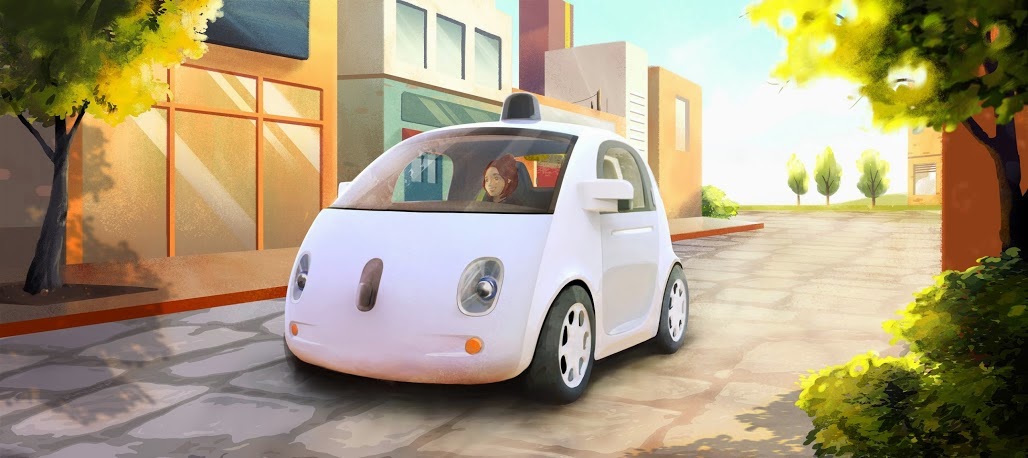
Google Revealed Self-Driving Car Prototype With No Steering Wheel Or Pedals
It was in the year 2010 that Google started developing that so called "self driving car" but later this summer, Google revealed it's prototype of a Self-Driving Car with no Steering Wheel or Pedals on it. Designed to operate safely and autonomously without requiring human intervention, this self-driving vehicle has Google Software and sensors which will do all the works and replaced those steering wheel, accelerator pedal, or brake pedal in ordinary cars.
 "The vehicles will be very basic—we want to learn from them and adapt them as quickly as possible—but they will take you where you want to go at the push of a button. And that's an important step toward improving road safety and transforming mobility for millions of people. " said in the post.
Take a look on this first Drive video.
"It was inspiring to start with a blank sheet of paper and ask, “What should be different about this kind of vehicle?” We started with the most important thing: safety. They have sensors that remove blind spots, and they can detect objects out to a distance of more than two football fields in all directions, which is especially helpful on busy streets with lots of intersections. And we’ve capped the speed of these first vehicles at 25 mph. On the inside, we’ve designed for learning, not luxury, so we’re light on creature comforts, but we’ll have two seats (with seatbelts), a space for passengers’ belongings, buttons to start and stop, and a screen that shows the route—and that’s about it." they added.
Know more about this project at their official Google Plus Page: https://plus.google.com/+GoogleSelfDrivingCars
Take a look on this first Drive video.
"It was inspiring to start with a blank sheet of paper and ask, “What should be different about this kind of vehicle?” We started with the most important thing: safety. They have sensors that remove blind spots, and they can detect objects out to a distance of more than two football fields in all directions, which is especially helpful on busy streets with lots of intersections. And we’ve capped the speed of these first vehicles at 25 mph. On the inside, we’ve designed for learning, not luxury, so we’re light on creature comforts, but we’ll have two seats (with seatbelts), a space for passengers’ belongings, buttons to start and stop, and a screen that shows the route—and that’s about it." they added.
Know more about this project at their official Google Plus Page: https://plus.google.com/+GoogleSelfDrivingCars
Intel: Advance Machine Intelligence

Intel Chief Technology Officer Justin Rattner snatches
an apple from the grasp of a robot arm and
hand that can sense objects purely
by changes in the surrounding electric field.

Zachary Drake of Emotiv Systems demonstrates
an interface that monitors external signals
of brain activity with a special headset
and then translates the data into actions
in a basic video game. Here, his angry
expression chases away glowing
sprites in a video game.

Drake makes a gesture to lift parts in a video game.

Jason Campbell, a senior staff scientist with Intel Research,
described devices called catoms that collectively
could be assembled into materials that are in effect programmable.
Here, he holds two basic models.
Intel expects catoms to be miniaturized over time.
Because catoms can communicate and interact
electromagnetically, they'll be able
to take up more or less volume, Intel said,
so that shape-shifting and
color-changing materials can be built from them.

This catom, shown close up, is bristling with electronic elements.
Catom is a Carnegie Mellon University
term standing for claytronics atom.

A shorter catom shows delicate copper wiring.

The Intel robot, called Herb, moves a mug without tipping it.
Had it been full of a liquid, that might have kept
it from spilling--up until the point when the robot
unceremoniously dropped the mug it into its storage bin.
Source: ZDNet Photo Gallery: Advancing Machine Intelligence


